
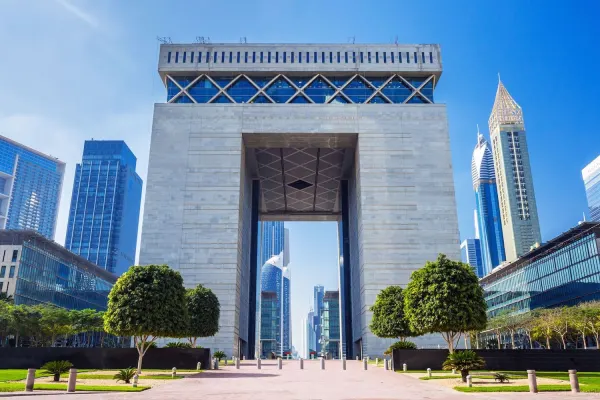
My birthday landed in the middle of a war.
On February 28, 2026, US-Israeli strikes hit Iran. Within days, the Dubai Financial Market had suspended trading for two sessions, Iranian drones had struck infrastructure across the Gulf, and the DFM General Index had fallen 17 percent from its February peak. The broader selloff wiped nearly $124 billion from the value of listed UAE companies.
I bought three stocks anyway. Emaar Properties, Emirates NBD, and Air Arabia. Not because I had a hot tip or a clever trading strategy. But because I live here. I understand these businesses. And I have a framework for thinking about moments like this.
This article is not investment advice. It is a walkthrough of how I think through a crisis-driven dip, using three real companies as examples. You can apply the same questions to any market, any city, any panic.
What Actually Happened to the Dubai Market
Before thinking about individual companies, you need to understand what happened to the market itself.
The Dubai Financial Market General Index, which includes companies such as Emirates NBD and Emaar Properties, had risen more than 29 percent in the 12 months to February 27. The market was running hot. Valuations had rerated upward. Then the conflict hit.
The UAE exchanges resumed trading on March 4 after being shut for two sessions. At the open, the Dubai Financial Market General Index plunged 4.65 percent to 6,201. Real estate and banking stocks bore the worst of it.
This matters for one simple reason. When a market drops 17 percent in eight trading sessions, the question is not just “are these good companies?” The question is: were these companies expensive before the drop, and what does the business actually look like underneath?

The Framework: Three Questions Before Buying a Dip
Every time I consider buying during a panic, I ask myself three questions.
Is the business model broken, or is the price broken?
A business model is broken when the fundamental way a company makes money no longer works. A price is broken when fear is bigger than facts. These are very different situations. Buying a broken business model at a discount is still a bad investment. Buying a solid business at a fear-driven price is the basis of long-term returns.
Does the company have a defensible position inside the city or economy it operates in?
Local dominance is real. A company that is embedded into how a city functions (its infrastructure, its banking, its skyline) is harder to displace than one competing in a global commodity market.
What does the underlying data say, independent of the news cycle?
Sentiment and fundamentals diverge all the time. The news tells you what people feel. The financials tell you what the business is actually doing. Both matter, but you need to separate them.
Emaar Properties: The Skyline Business
Emaar built the Burj Khalifa. It runs The Dubai Mall. It develops the communities that define what Dubai looks, feels, and sells like to the world. This is not a speculative developer. It is the physical infrastructure of modern Dubai.
Before the conflict hit, the numbers were exceptional. In 2025, Emaar achieved its highest-ever property sales of AED 80.4 billion, alongside record revenue of AED 49.6 billion and net profit before tax of AED 25.7 billion. The company was not a distressed business heading into the selloff. It was at a record.
Here is what the key ratios look like right now:
| Metric | Value | What it means |
|---|---|---|
| P/E Ratio | ~7.7x | Well below its 10-year average of ~8.1x. Cheap by its own history. (Source: Wisesheets) |
| Net Profit Margin | ~38% | Keeps a large slice of every dirham earned. (Source: Investing.com) |
| Return on Equity | ~18 to 22% | For every dirham shareholders put in, Emaar generates 18 to 22 fils back annually. Ranked better than 90% of global real estate companies. (Source: Gurufocus, Stock Analysis) |
| Dividend Yield | ~7.8 to 8.9% | High income while you wait. Payout ratio of ~50%, so dividends are well covered by earnings. (Source: Simply Wall St) |
| EBITDA Margin | ~49% | Nearly half of revenue converts to operating profit before interest and taxes. (Source: TradingView) |
| Net Cash Position | +AED 7.5bn | More cash than debt. A healthy buffer in uncertain times. (Source: Stock Analysis) |
| Revenue Backlog | AED 155bn | Revenue already locked in from signed contracts and that is over 3x annual revenue. (Source: Emaar Press Release) |
The P/E of 7.7x is the number that stands out. Global real estate companies often trade at 20 to 30x. Even allowing for the regional risk premium attached to UAE names, Emaar at under 8x earnings, with a 49 percent EBITDA margin and a net cash balance sheet, reflects a lot of fear already baked into the price.
The revenue backlog is the most important number. The company’s revenue backlog reached AED 155 billion as of December 31, 2025, providing strong visibility over future earnings and cash flows. A backlog that large means revenue is already largely locked in, regardless of near-term sentiment. Sales contracts signed before the conflict do not disappear because of a geopolitical shock.
UAE property sales reached AED 17.2 billion in the first two months of 2026, compared to AED 7.9 billion during the same period in 2025, an increase of 118 percent year-on-year. That momentum existed before February 28.
The honest risk is real. UAE corporate bonds are among the worst performers in emerging markets this month, with real estate names suffering the heaviest losses. Sentiment damage to Dubai’s brand as a stable destination for global capital is a genuine concern. The question is duration: how long does uncertainty last, and how much of the backlog converts to revenue regardless?
Emirates NBD: The Bank Behind the Economy
Every transaction in Dubai eventually touches the banking system. Emirates NBD is the largest bank by assets in Dubai, and it functions less like a typical stock market bet and more like a direct stake in the financial infrastructure of the emirate.
The 2025 results reflected that. Emirates NBD reported a 4 percent year-on-year increase in net profit to AED 24 billion for 2025. Total income rose 12 percent to AED 49 billion.
Here is the ratio picture:
| Metric | Value | What it means |
|---|---|---|
| P/E Ratio | ~7.6 to 8.3x | Trading below its estimated fair P/E of ~9.5x. (Source: Simply Wall St, Wisesheets) |
| Return on Equity | ~18 to 19% | Ranked better than 88% of global banks, whose median ROE is ~9.6%. (Source: Gurufocus) |
| Price-to-Book | ~1.23x | Trading near book value and that means you are buying the bank’s assets at close to their stated worth. (Source: Kamco Invest) |
| Dividend Yield | ~3.7% | Paid AED 6.3bn in dividends for 2025 and a concrete cash return regardless of market swings. (Source: AGBI) |
| Loan Growth (YTD) | +19% vs industry +7.6% | Outgrowing peers by a wide margin, with AED 95bn in new corporate lending originations. (Source: Kamco Invest) |
| 52-week range | AED 18.25 to AED 37.40 | Stock was near its 52-week lows as of mid-March, well off its pre-conflict high. (Source: Investing.com) |
An ROE of 18 to 19 percent is genuinely impressive for a bank. The industry median globally sits around 9.6 percent. Based on Q3 2025 data, Emirates NBD was trading at a price-to-tangible book value of 1.23x with an ROE of 20.2 percent, compared to peer averages of 1.81x and 20.4 percent respectively. In other words, you are getting similar returns to peers at a meaningfully cheaper price. (Source: Kamco Invest)
The expansion story adds another layer. The bank has grown into Egypt, India, and Saudi Arabia, offering strong balance sheet resilience and regional diversification. Geographic diversification means the bank’s earnings are not entirely dependent on what happens inside the UAE in any given quarter.
Banks do carry specific risks in conflict scenarios. If tourism dries up, real estate transactions slow, and business activity contracts, loan demand falls. An assistant professor of finance at the American University in Dubai noted that while the UAE could see some outflow of foreign capital, the country’s economy remains on a strong footing. A short-lived disruption is a very different scenario from a prolonged structural shift.
Air Arabia: The Budget Carrier Built for This Region
Air Arabia is the Middle East and North Africa’s first and largest low-cost carrier, headquartered in Sharjah. It is the most obviously exposed of the three stocks to the conflict. When airspace closes and flights are grounded, an airline feels it immediately. That is exactly why the price moved so sharply, and why it is worth looking at the business underneath.
The 2025 full-year results, reported just two weeks before the conflict began, were a record. Air Arabia posted a pre-tax net profit of AED 1.8 billion for 2025, a 14 percent increase on 2024. Total revenue surpassed AED 7.78 billion, up 15 percent year-on-year. The board proposed a cash dividend of 30 fils per share. (Source: Air Arabia Press Release, February 12, 2026)
Here is what the ratios look like:
| Metric | Value | What it means |
|---|---|---|
| P/E Ratio | ~12x | Reasonable for a profitable, growing airline. Well below global low-cost carrier peers. (Source: Investing.com) |
| Net Profit Margin | ~21% | Exceptional for aviation, where most carriers struggle to break 10%. (Source: Investing.com) |
| EBITDA Margin | ~24% | Solid operational efficiency across its six hub network. (Source: TradingView) |
| Dividend Yield | ~6.2 to 7.0% | High yield with a payout ratio of ~61 to 86%, covered by earnings. 5-year dividend growth rate of ~23%. (Source: Investing.com, Simply Wall St) |
| Revenue Growth (2025) | +15% | Revenue up from AED 6.76bn to AED 7.78bn with 30 new routes added. (Source: Air Arabia) |
| Debt position | Nearly debt-free | Borrowings close to zero. Lease liabilities of ~AED 1.9bn, offset by cash of AED 5.3bn. (Source: FAB Research) |
| Seat load factor (2025) | 85% | Up 4 percentage points year-on-year, reflecting strong demand for its routes. (Source: Air Arabia) |
The 21 percent net profit margin is the number that stops you in your tracks. Most airlines in the world operate on margins of 3 to 8 percent in a good year. Air Arabia runs at over 20 percent. That is a function of its low-cost model, its lean fleet of Airbus A320 and A321 aircraft, and its focus on short-to-medium haul routes across a region with structurally high travel demand.
The near-zero debt position matters enormously here. Airlines are capital-intensive businesses. Most carry significant debt. A conflict-driven revenue shock to a heavily indebted airline can become an existential problem fast. Air Arabia entered this crisis with a cash balance of AED 5.3 billion and almost no borrowings. That is a very different position to be in when airspace closes for a few weeks.
The honest risk is also the most obvious: this is an airline, and airspace was literally closed. Air Arabia suspended UAE operations until March 9 and the recovery of passenger volumes will take time. The stock dropped sharply and the near-term earnings picture is genuinely uncertain. This is not a situation where the price moved on fear alone. There is real near-term revenue impact. The question, as always, is whether the business comes back. For a carrier with 85 percent seat load factors, 30 new routes added in 2025, and a Saudi low-cost airline partnership underway, the long-term demand story looks intact.
What the History of Geopolitical Selloffs Suggests
This is where I always step back and look at the broader pattern. History is littered with events that were seen as near-cataclysmic at the time, but which ultimately were not detrimental for markets in the long-term. That does not mean every crisis resolves quickly. It means markets have a strong historical tendency to price in fear faster than the actual economic damage unfolds.
The DFM was at a 20-year peak just before the conflict. The UAE market crash followed a sustained bull run that culminated in mid-February as Dubai’s index hit a 20-year peak. Part of the selloff is fear. Part of it is also a correction from elevated valuations. Both are true at the same time.
The Framework Applied
| Company | P/E | Dividend Yield | ROE | Key Strength | Key Risk |
|---|---|---|---|---|---|
| Emaar | ~7.7x | ~7.8 to 8.9% | ~18 to 22% | AED 155bn backlog; net cash balance sheet | Brand damage to Dubai; prolonged conflict |
| Emirates NBD | ~7.6 to 8.3x | ~3.7% | ~18 to 19% | Loan growth 2.5x industry; regional expansion | Loan demand slowdown; capital outflows |
| Air Arabia | ~12x | ~6.2 to 7.0% | ~20% | 21% net margin; nearly debt-free; 85% seat load | Real near-term revenue loss; airspace disruption |
None of these pass every test with flying colours right now. All of them have defensible business models, strong pre-conflict financials, and embedded positions inside the city’s infrastructure. The market has priced in fear. Whether that fear is fully justified or partly excessive is the judgment call every investor has to make for themselves.
I made mine on my birthday. Time will tell if I was early, right, or both.
What This Teaches About Investing in Familiar Markets
There is an old idea in investing sometimes called the home advantage. You understand your local environment in ways that distant analysts do not. You see the cranes still building. You use the bank. You park your car. You have ground-level data that no spreadsheet captures perfectly.
That edge only matters if you combine it with honest analysis. Familiarity can become bias. Loving a city does not make every stock in it a buy. The questions still have to be asked. The downside still has to be considered.
What local knowledge gives you is conviction when others are running. And conviction, applied carefully and not recklessly, is one of the most useful things a long-term investor can have.
Disclaimer:
The content on this blog (Zorroh) is provided for general informational and educational purposes only. It is not intended as investment, financial, tax, legal, or other professional advice. Past performance is not indicative of future results. Investing involves risk, including possible loss of principal. Always conduct your own research or consult a qualified professional before making investment decisions.