
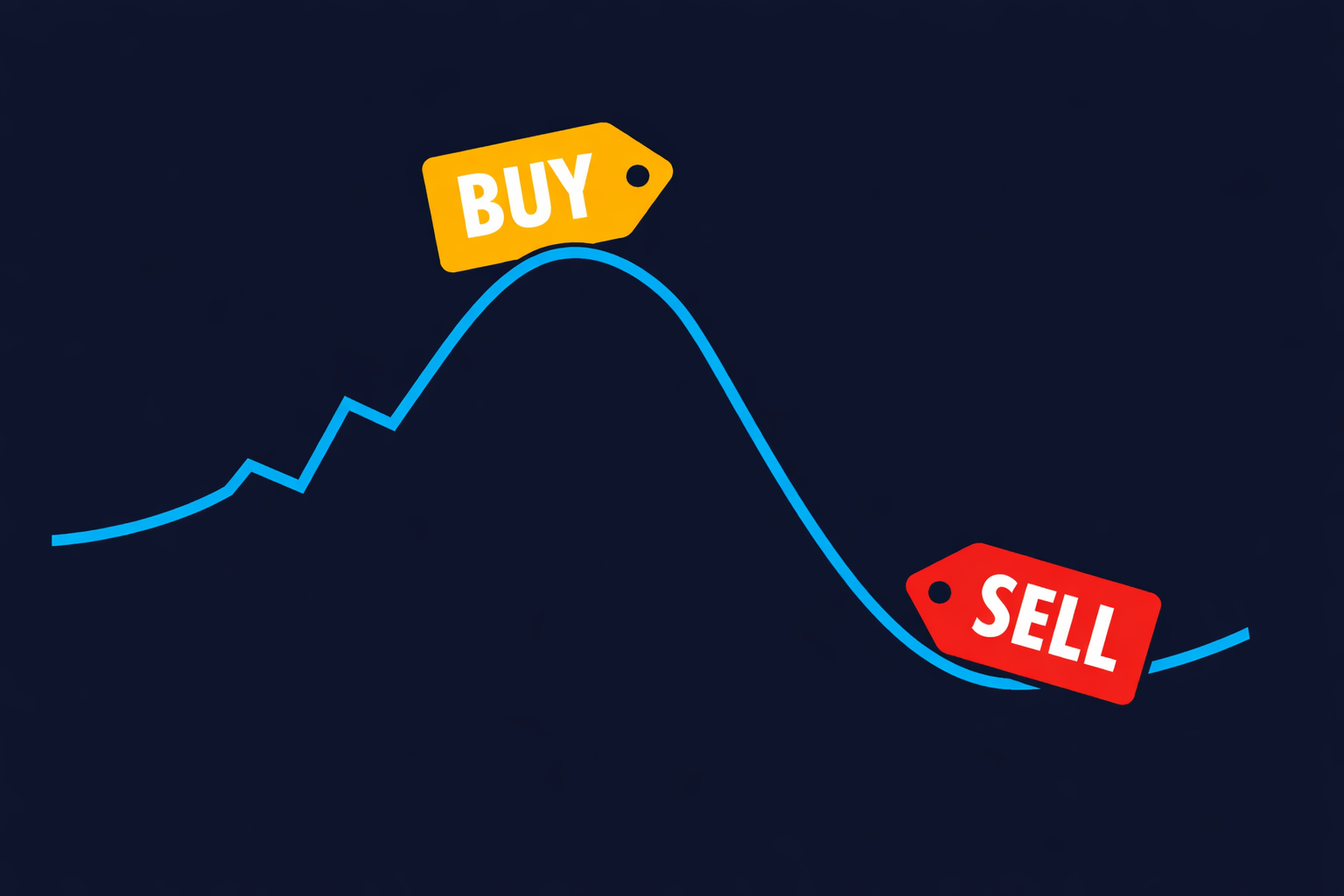
There is a gap between the return an investment delivers and the return an investor actually receives. It is one of the most documented and persistent findings in behavioural finance, and it costs ordinary investors a meaningful slice of their long-run wealth.
The pattern is consistent across decades, geographies, and fund types: investors tend to put money in after prices have already risen and pull money out after prices have already fallen. They buy high and sell low – not because they are irrational, but because the feelings that drive those decisions are entirely human.
This article explains why it happens, what the data shows, and what you can do to avoid it.
The Evidence: The Behaviour Gap
Every year, Morningstar publishes a study called the Mind the Gap report. It measures the difference between the total return a fund earns and the dollar-weighted return investors in that fund actually receive. The difference — the gap — reflects the timing of investor cash flows. (Source: Morningstar – Mind the Gap)
The 2024 edition of the report found that over the ten years ending December 2023, the average fund returned 7.3% per year. The average investor in those same funds earned only 6.3%. That one percentage point gap, compounded over a decade, amounts to a meaningful loss of wealth — not from picking bad funds, but from buying and selling at the wrong times. (Source: Morningstar – Mind the Gap 2024)
The gap is not evenly distributed. It is widest in the fund categories with the most volatility and narrative excitement. Sector funds and thematic funds showed the largest gaps, often exceeding 2% to 3% per year. Broad diversified funds showed the smallest gaps. The more exciting the fund, the more investors traded it poorly. (Source: Morningstar – Mind the Gap 2024)
The problem is not usually the fund. It is the timing of the investor who owns it.
Fund flows confirm the pattern
Fund flow data is one of the clearest windows into collective investor behaviour. When investors are confident and markets have already risen, money pours in. When markets fall and uncertainty rises, money flows out. The pattern repeats across virtually every market cycle on record.
| Period | What markets did | What fund flows showed |
|---|---|---|
| Late 1999 – early 2000 | Nasdaq near all-time highs | Record inflows into technology and growth funds |
| 2002 – 2003 | Markets near post-Dot Com lows | Heavy outflows from equity funds |
| 2007 – 2008 | Markets near pre-crisis highs, then crash | Strong inflows in 2007, massive outflows in 2008 and 2009 |
| March 2020 | Sharp COVID-19 drawdown | Significant outflows at or near the bottom |
| 2021 – 2022 | Speculative peak then sharp correction | Meme stocks and thematic ETFs saw record inflows in 2021, then outflows as they fell |
| 2023 – 2024 | AI and mega cap rally | Heavy inflows into technology sector funds near multi-year highs |
The 2023 to 2024 Technology sector outflows seen in early 2026 are the flip side of this same dynamic. Money poured into tech at elevated valuations; when the sector cooled, flows reversed. (Source: Zorroh – Sector Rotation in 2026)
Why It Happens: The Psychology
Buying high and selling low is not stupidity. It is the predictable result of a handful of well-documented psychological tendencies interacting with volatile markets.
Recency bias
We overweight recent events when forming expectations about the future. After a strong year for equities, it feels like equities will continue to perform well. After a brutal drawdown, it feels like losses will keep coming. Neither feeling is a reliable signal — but both are powerful enough to drive real decisions. (Source: DALBAR – Quantitative Analysis of Investor Behaviour)
Loss aversion
Research by Daniel Kahneman and Amos Tversky established that losses feel approximately twice as painful as equivalent gains feel good. A $1,000 loss hurts more than a $1,000 gain satisfies. This asymmetry makes it very hard to hold through a drawdown. The pain of watching a portfolio fall can become intense enough to override any rational long-term view. (Source: Kahneman and Tversky – Prospect Theory, Econometrica 1979)
The fear of missing out
When a fund, sector, or asset class has been in the news for months and everyone seems to be making money, it becomes very difficult to stay on the sidelines. The feeling that you are missing something — that other people are getting rich and you are not — is a powerful motivator. It is often what draws the last wave of buyers into a crowded trade near its peak.
Narrative thinking
Markets move on data. Investors move on stories. A compelling narrative — AI will change everything, clean energy is inevitable, this economy is different — makes it easy to justify buying something that has already run significantly. The story feels more real when prices have confirmed it. But prices confirming a story is often not a reason to buy; it is a sign that the story is already priced in.
Herding
Human beings are social animals. When those around us are buying, selling feels wrong. When those around us are panicking, staying calm feels wrong. Herding is the tendency to align our behaviour with the crowd — a useful instinct in many parts of life, but a destructive one in investing, where crowds are often late.
What the Numbers Cost You
DALBAR has tracked the gap between S&P 500 returns and the returns average equity fund investors actually received for more than thirty years. The results are sobering. (Source: DALBAR – Quantitative Analysis of Investor Behaviour 2023)
| Period (ending 2022) | S&P 500 annualised return | Average equity investor return | Gap |
|---|---|---|---|
| 1 year | -18.11% | -21.17% | -3.06% |
| 10 years | 12.56% | 8.93% | -3.63% |
| 20 years | 9.40% | 6.81% | -2.59% |
| 30 years | 10.65% | 7.13% | -3.52% |
A 3.5% annual gap may not sound dramatic. But compounded over 30 years, it is the difference between turning $10,000 into approximately $200,000 (at 10.65%) and turning it into approximately $77,000 (at 7.13%). Same market. Very different outcome — driven entirely by timing decisions.
The Missing Days Problem
One of the most cited findings in this area is how much a small number of trading days drive long-run equity returns. Missing the best days in the market — which tend to cluster right around the worst periods, when investors are most likely to have sold — has an outsized impact on outcomes. (Source: J.P. Morgan Asset Management – Guide to the Markets)
| Scenario (S&P 500, 20 years ending Dec 2023) | Annualised return | $10,000 grows to |
|---|---|---|
| Fully invested throughout | 9.7% | ~$62,600 |
| Missed the 10 best days | 5.5% | ~$29,200 |
| Missed the 20 best days | 2.8% | ~$17,300 |
| Missed the 30 best days | 0.4% | ~$10,900 |
| Missed the 40 best days | -1.9% | ~$6,900 |
The best days and the worst days are neighbours. Seven of the ten best days in that period occurred within two weeks of the ten worst days. An investor who sold during a sharp downturn and waited for things to “calm down” before reinvesting is almost structurally guaranteed to miss the fastest part of the recovery. (Source: J.P. Morgan Asset Management – Guide to the Markets 2024)
How to Avoid It: Practical Approaches
Knowing the pattern exists is not enough to make it stop. The feelings that drive poor timing decisions are real and persistent. The solution is not to become emotionless — it is to build systems that make the right behaviour automatic and the wrong behaviour harder.
1. Automate your contributions
Regular automatic contributions — the same amount, on the same date, regardless of what markets are doing — remove the decision entirely. This approach is called pound-cost averaging or dollar-cost averaging depending on where you are. It does not guarantee a profit or protect against loss, but it does prevent you from piling in at the top or staying out at the bottom.
When markets fall, your fixed contribution buys more units. When markets rise, it buys fewer. Over time, this naturally lowers your average cost per unit relative to investing a lump sum at an arbitrary point.
2. Write down your plan before you invest
Before you invest, write down three things: what you are buying and why, what return you expect over what time horizon, and what you will do if it falls 30%. The last question is the most important. Most people have never thought clearly about how they will behave in a drawdown — and that lack of preparation is exactly what leads to panic selling.
A written plan is not a contract. But it gives you something to read during a market panic, when your future self might make very different decisions from your calm, pre-invested self.
3. Match your portfolio to your actual risk tolerance — not your aspirational one
Most investors overestimate their tolerance for volatility when markets are calm. It is easy to say you can handle a 40% drawdown in theory. It is much harder to sit through one in practice when the number on the screen represents years of savings.
A portfolio that is slightly less aggressive than your theoretical optimum — one you can actually hold through a downturn without selling — will almost always outperform a more aggressive portfolio that you abandon at the first serious fall. The best portfolio is not the one with the highest expected return. It is the one you can stay in. (Source: Zorroh – Diversification in Investing)
4. Use rebalancing as your action channel
The urge to do something when markets move is real. Giving that urge a structured outlet is more effective than telling yourself to ignore it. Rebalancing is a constructive action: it keeps your portfolio aligned, and it naturally directs you to buy what has fallen and reduce what has risen — the opposite of the behaviour the gap measures. (Source: Zorroh – What Is Rebalancing and Does It Actually Help?)
5. Reduce the signal-to-noise ratio
The more you check your portfolio, the more short-term fluctuations feel meaningful. Daily checking creates emotional responses to noise. Quarterly or semi-annual reviews are enough for most long-term investors. You do not need to know what the market did today to make good decisions about money you need in twenty years.
Similarly, be careful about the media you consume around investing. Financial news is optimised for attention, not for helping you hold a diversified portfolio through a slow, boring decade. Urgency and fear sell. Patience does not.
6. Be sceptical of thematic excitement
Morningstar’s data consistently shows the largest behaviour gaps in thematic and sector funds. The pattern is predictable: a theme emerges, a fund launches or grows rapidly, mainstream coverage follows, retail investors pile in near the peak, and returns subsequently disappoint. The theme might be real. The question is what the market has already priced in by the time most investors hear about it. (Source: Morningstar – Mind the Gap 2024)
A Summary of the Traps and the Fixes
| Behavioural trap | What it looks like | What helps |
|---|---|---|
| Recency bias | Buying a fund because it performed well last year | Focus on long-run strategy, not recent performance |
| Loss aversion | Selling during a downturn to stop the pain | Pre-commit to a drawdown plan before investing |
| FOMO | Buying a crowded trade because everyone else is | Recognise that coverage and hype follow price, not signal |
| Narrative thinking | Justifying a rich valuation because the story is compelling | Ask: is this already priced in? |
| Herding | Selling because others are, or buying because others are | Automate contributions and rebalancing to remove discretion |
| Over-monitoring | Checking the portfolio daily and reacting to noise | Set a review schedule and stick to it; quarterly is enough |
Try It Yourself: The Zorroh Portfolio Analyzer
One of the most instructive exercises you can do is to look at what a simple buy-and-hold portfolio actually delivered over the last decade — and then compare that to what someone who timed the market would have experienced. Use the Zorroh Portfolio Analyzer to run your own version of this comparison.
🧭 Suggested test: The cost of bad timing
- Portfolio 1: SPY at 100% — buy and hold, quarterly rebalancing.
- Portfolio 2: A mix with a higher bond allocation (eg. 60% SPY + 40% AGG) — a portfolio someone with lower risk tolerance might actually stick to.
- Date range: 2010 to 2026, to include the 2020 crash, the 2022 drawdown, and both the bull and rotation periods.
- What to look for: Max Drawdown — what is the worst point someone in each portfolio would have had to stomach? Sharpe Ratio — which approach delivered better risk-adjusted returns? CAGR — did the more aggressive portfolio actually win over the full period after accounting for the behavioural drag of those bigger drawdowns?
Final Takeaway
The behaviour gap is not a fringe finding. It has been measured across thirty years of fund flow data, across geographies, and across asset classes. Investors consistently earn less than the funds they own — and the gap is widest when markets are most exciting.
The solution is not to be smarter than the market. It is to make fewer decisions. Automate contributions. Write down your plan. Rebalance on a schedule. Check less often. And be suspicious of any investment that has recently been in every headline.
Time in the market beats timing the market. That phrase has become a cliché because the data, decade after decade, keeps confirming it.
Disclaimer:
The content on this blog (Zorroh) is for educational purposes only and does not constitute investment advice. Past performance is not indicative of future results. Investing involves risk, including possible loss of principal. Always conduct your own research or consult a qualified professional before making investment decisions.