
In March 2020, the S&P 500 fell 34% in 33 days. Retail investors panicked and sold. By August, the index had fully recovered. The investors who sold locked in real losses. The ones who stayed locked in a full recovery.
In January 2021, GameStop hit $483. Reddit forums were flooded with people posting life-changing gains. A wave of new investors piled in at the top. Within weeks it had fallen more than 80%.
In late 2021, crypto was everywhere. Bitcoin hit $69,000 in November. Altcoins were doubling weekly. People who had never invested before opened accounts. Bitcoin fell 65% over the following year.
In 2023 and 2024, Nvidia doubled, then doubled again, then doubled again. The AI chip story was real and the returns were extraordinary. But most of the retail money that chased the trade arrived late, after the big move, and has spent 2026 riding a volatile round trip.
These are not random events. They follow a pattern. And that pattern has a name.
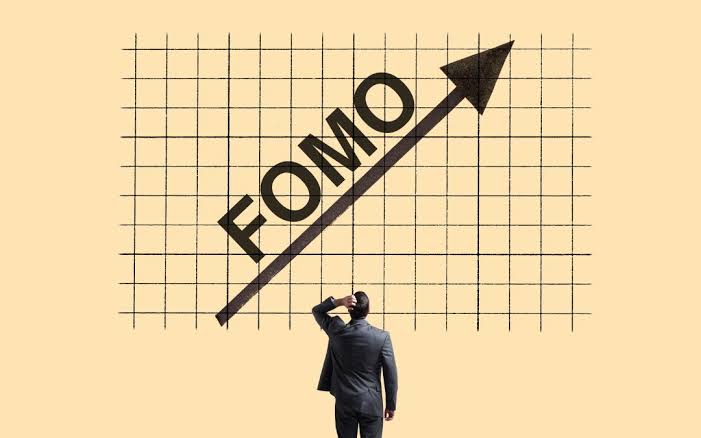
What FOMO Actually Is
Fear of missing out is not exclusive to investing. But investing is where it does the most financial damage.
The mechanism is straightforward. An asset moves sharply higher. Coverage spreads, first in financial media, then in mainstream news, then across social platforms. Friends mention it. Someone in a group chat posts a screenshot of their gains. The discomfort of not participating starts to outweigh the instinct for caution.
So you buy. Usually not at the start of the move. Usually somewhere near the middle or the top, precisely when the story has become impossible to ignore.
University of Colorado economist Yosef Bonaparte built what he calls the Global FOMO Index, tracking Google searches for terms like “buy stock,” “get rich quick,” “missed out,” and “Bitcoin price.” His findings are blunt: periods of peak search activity for these terms consistently predict lower market returns, not higher ones. When FOMO is at its peak, average subsequent returns drop by 1.7% to 2%, and risk-adjusted performance falls by roughly 4%. (Source: Morningstar; Evidence Investor)
When everyone is searching for how to buy something, they are not discovering an opportunity. They are arriving at the end of one.
The Same Story, Different Asset
What makes FOMO so persistent is that it does not learn from the last cycle. The asset changes. The structure of the mistake stays identical.
Covid selloff, March 2020
Retail investors sold at the bottom of the fastest bear market in history. Pure panic. The market recovered completely within five months. Those who sold missed the entire recovery while those who held or bought during the dip were rewarded handsomely.
GME and AMC, early 2021
Meme stocks became a cultural moment. GameStop rose 1,500% in weeks. The people who made extraordinary returns were the ones who were already in, often for entirely different reasons. The wave of FOMO buyers who arrived at $300 and above absorbed the losses when reality reasserted itself.
Crypto, November 2021
Bitcoin at $69,000. Altcoins with no underlying value hitting all-time highs weekly. The Global FOMO Index spiked to its highest level since 2018. Twelve months later, Bitcoin had fallen 65% and many altcoins had lost 90% or more.
AI chips and data centres, 2023 to 2026
This one is more nuanced because the underlying thesis is real. AI infrastructure spending is genuinely large and growing. But Nvidia at a 40x earnings multiple after a 600% run in 18 months prices in a lot of that story already. The investors who benefited most were the ones who owned semiconductor exposure before the narrative went mainstream. The ones who piled in during peak headlines in late 2024 and early 2025 have largely spent 2026 in a volatile holding pattern.
Bitcoin above $100,000, late 2024
Following Trump’s re-election and a wave of institutional adoption headlines, Bitcoin surged past $100,000 for the first time. FOMO search activity hit a new peak. Most retail buyers at that level have since experienced significant drawdowns. (Source: Morningstar)
The underlying asset in each case was different. The psychological mechanism was identical: the move happened, coverage followed, retail money arrived, the easy gains were already gone.
The Data Behind the Feeling
FOMO trades have a 31% win rate. Planned, non-FOMO trades from the same investors have a 52% win rate. The same analysis found that 41% of FOMO trades trigger revenge trading cascades, where one emotionally-driven loss leads to a series of escalating, increasingly irrational attempts to recover it. (Source: Traders Second Brain)
Across retail investors broadly, 90% underperform their benchmark over meaningful time horizons, and 55% underperform after fees and taxes even over shorter periods. (Source: ZipDo)
This is not primarily a skill gap. It is a behaviour gap. The index is available to everyone. The returns most people actually capture are substantially lower, because of what they do in response to headlines, narratives, and the discomfort of watching others appear to win.
Why It Keeps Happening Anyway
Knowing that FOMO is destructive does not make it easy to resist. That is because it does not feel like fear when you are in it. It feels like urgency. Like information. Like a rational response to obvious evidence.
Everyone posting gains from GameStop in January 2021 was not lying. Those gains were real, for the people who were already in. What looked like evidence that the trade was working was actually evidence that the opportunity had already passed for latecomers.
Social media has made this significantly worse. Gains get shared. Losses do not. The algorithm surfaces the most extreme outcomes. What looks like a wave of successful investors is actually a highly curated sample of the best results from a much larger group of people who mostly lost money.
This is the same mechanism explored in our articles on why investors buy high and sell low and portfolio checking frequency. The emotional pull is real. The financial outcome is predictable.
What Actually Works Instead
The story going mainstream is a signal to slow down, not speed up
By the time an investment thesis is on the front page of financial media, in every LinkedIn feed, and in your group chats, the people who benefited most from it have usually been positioned for months or years. The question to ask is not “should I buy this?” but “who am I buying from, and why are they selling to me now?”
Dollar-cost averaging removes the FOMO decision
Dollar-cost averaging is boring by design. A fixed amount, invested on a fixed schedule, into a diversified portfolio, regardless of what the market narrative is doing that week. It does not capture the peak of every cycle. It also does not result in buying GameStop at $400. The discipline of the system replaces the discipline of trying to resist FOMO in real time, which is very hard.
Diversification means you are never entirely missing out
A portfolio spread across global equities, sectors, and asset classes will always contain exposure to whatever is currently leading the market. When AI chips ran, an investor in a broad global ETF participated in that upside, partially and proportionally, without having to make a concentrated bet at the top. That partial participation is not failure. It is the point.
Your time horizon is the antidote
FOMO is a short-term emotion triggered by short-term price movements. A 20-year investing horizon makes almost every FOMO moment irrelevant. The question is not whether Nvidia outperforms over the next three months. It is whether a diversified global portfolio grows over the next two decades. Those are very different questions, and only one of them requires you to watch LinkedIn on a Tuesday afternoon.
For more on building a portfolio that does not depend on getting the timing right, our asset allocation by age guide covers how to structure your investment mix so that any single narrative, however compelling, cannot derail the long-term plan.
The Takeaway
Every major FOMO cycle of the last five years has followed the same script. Price moves sharply. Attention follows. Retail money arrives. The early holders sell to the late arrivals. The late arrivals hold through the drawdown.
The Global FOMO Index spikes at market peaks, not bottoms, because that is when the noise is loudest and the opportunity is smallest.
The investors who have consistently done best over this period were not the ones who identified the right asset at the right moment. They were the ones who had a plan, stuck to it, and were still invested when the recovery came.
FOMO will return. It always does. The next version will feel different from the last, because the asset will be different and the story will be new. But the structure of the mistake will be identical.
Disclaimer:
The content on this blog (Zorroh) is provided for general informational and educational purposes only. It is not intended as investment, financial, tax, legal, or other professional advice. Past performance is not indicative of future results. Investing involves risk, including possible loss of principal. Always conduct your own research or consult a qualified professional before making investment decisions.